• The Bakerloop

    Read all about TfL's latest Superloop route here!

  • The Electric Takeover

    Keep up with all the electric buses with London Connected!

  • About Us!

    Get to know the team who have been fuelling the blogging community for 10 years.

  • Service changes

    Keep up-to-date with the Tenders page or visit us on Flickr for additional content.

  • Back On Track

    Expanding our coverage from the bus scene to the rail network.

  • Busy Bus Buzz

    Everyone's welcome to join and share their opinions on London's transport scene. All the news, views and more daily on our chatbox. Powered by Chatango

Showing posts with label 5 Years and STILL Going Strong. Show all posts

H is for Hampstead

What was once a rapidly growing stronghold for Arriva in the mid 2000s in North West London quickly began to collapse over the last year. Now that the Garston (GR) garage is, to the writer, sadly closed for business, several gains have been made by Metroline and London Sovereign.

Arriva 2469 at Golders Green on route H2, July 2013.
For a garage that is minutes away from the London Orbital Motorway, it was an amazement that they had for 12 years managed to operate four different bus routes that infiltrate the depths of zone 2 - and quite well service wise too.

Arriva from 2006 to 2018 were the proud custodians of routes 268 (between Finchley Road and Golders Green), the H2 and H3 (both circular services around the Hampstead Garden Suburbs and the fringes of East Finchley) and the school route 631.

Route 631 is one of few school bus routes in London to be a single decker, and more so, a 7.8m one-door single decker bus with a very low capacity. To compensate, this bus route runs every a number of trips each way over the course of an hour to allow students and staff to get to and from the school and Golders Green Station.

Route H3 runs Monday to Saturday during shopping hours every hour after 9am until 2pm however it interestingly has one bus during the morning peak. Route H3 runs through the Hampstead Garden Suburb before weaving in and out of Hampstead Heath, and the entrance of the well known Kenwood House and also running along 'Millionaires Row', a colloquial name often given to The Bishops Avenue, East Finchley.

The main service for the Hampstead Garden Suburb is the bus route H2, which for a 7.8m single decker Optare Solo bus route, may come as a surprise that it's a high frequency route. The circular service which works its way around a myriad of roads around the Garden Suburb up to Market Place and back operates every 12 minutes.

The 631, H2 and H3 operated from a pool of just a mere 5 Optare Solos that were introduced new to the route in 2006. The fleet number of one of the buses, 2468, notoriously stood out for having a consistent pattern - Abellio's 2468 (which is 8 years younger than Arriva's), Stagecoach's 12321, 12345 and Metroline's TEH1234 also were known for this. The schedule for all 3 routes saw a considerable amount of crosslinking between routes to make use of most of the buses they had available. The total PVR was 4 to run all 3 services - 3 for the H2, and 1 for the 631 and H3 (when the H3 wasn't running, the bus was a 631, and vice versa) with one maintenance vehicle.

Arriva 2468 on school route 631 when first introduced in
July 2013.
When Garston (GR) was absorbed into Arriva London, the vehicles were renumbered from 2468-2472 to OS68-72. The vehicles can't be longer than 7.8m due to the incredibly tight roads around the Garden Suburb which are incredibly difficult to navigate.

The buses by the end of the contract were beginning to show their age and were plagued with reliability problems, possibly as a result of the high mileage achieved from doing the incredibly demanding runs up and down the M1 daily which the buses weren't built for.

Taking over a route comes with its problems
Upon the latest rounds of tendering for the Hampstead Garden Suburb routes, Metroline managed to nab control of the routes again out of their flagship Cricklewood (W) garage. They took on the routes during the early summer of 2018, however suffered an issue relating to the late delivery of their custom-spec Optare Solo SR vehicles. This meant that routes 631, H2 and H3 had to continue using their existing vehicles from Arriva, which were loaned to Metroline for a number of weeks.

But due to the poor state of these vehicles, Metroline had to loan an Ellenvale Optare Solo as well temporarily in all white and LEDs, but fitted with an Oyster reader as a top up vehicle to ensure the service wasn't disrupted. It was quite interesting to see an all-white LED bus with seatbelts and high back seats!

The Ellenvale Solo, YJ67 GEK, at Golders Green on H2 duties. ©️ LBOTG


Eventually, the new Metroline Optare Solo SRs were unveiled at their annual Holloway Garage (HT) open day in the summer of 2018, kitted off with LEDs - which is not part of an ongoing trial at Stagecoach London - these are simply because conventional blinds take up too much space on what is otherwise an incredibly tiny bus. The LEDs were designed in-house by the skilled scheduling team at Metroline who have made some impressive displays - including the not in service one which shows a stream of 'ZZZs' implying the bus is sleeping.

These buses entered service with numbers OS2499-2504 in September. Here's a quick fleetlist below:

YJ68 FXA - OS2499
YJ68 FXB - OS2500
YJ68 FXF - OS2501
YJ68 FXC - OS2502
YJ68 FXE - OS2503
YJ68 FXG - OS2504

And a photo to show the new Optare Solos in action:

OS2501 entering Golders Green  ©️ LBOTG
Due to the limited availability of our bloggers, we unfortunately can't show you a photo of Metroline on the H3 at present. However, this is a good opportunity to tune into our dedicated Flickr group which has a wide array of photos from the London Bus Scene.

From Garston to Swiss Cottage
Route 268 also shifted from Garston (GR) to Cricklewood (W), using some spare Metroline Travel Enviro 200s that had come spare from routes 46 and 274 as a result of both routes getting new, more environmentally clean buses. Whilst for many years the route 268 was operated using the traditional Arriva London Wright Cadet buses, as reliability began to also not become their strong point (there's a running theme here...), some Enviro 200s released from Stagecoach's loss of route 469 were acquired in late 2015.

ENL106 on stand at Golders Green Station, August 2016.

These were given a deep clean and some new blinds and whilst they could be found on most routes, the allocators had chosen to keep them as much as possible on route 268 as the Cadets were becoming mechanically troublesome during the long dead run down the M1 every day, whereas the Enviro 200s managed these runs better.

Following the move of the route to Cricklewood (W), these ex-Stagecoach ENLs were now homeless again and shortly after had found a new life on the route 166 out of Croydon (TC) garage running between West Croydon, Bus Station and Epsom Hospital in Surrey.

Some other buses have been reblinded for the 268 as well, most notably the LK10-plated DEs that reside at Cricklewood and operate routes 232 and C11.

DE1127 seen at Golders Green Station inbetween 268 duties.
With things mostly settling down now, Metroline have managed to do themselves well on these tender wins. We can only wish them the best of luck for the next five years.

With massive thanks to London Buses: On The Go for lending us his brilliant photos. View his blog here, and you can also view his Flickr stream here.

Thanks for reading and do stay safe! Have a happy new year 2019!

Our 5th Year: A Cinderella Story

It's fair to say that the rail industry has been really interesting as of late. To celebrate the 5th year, we take a look at one of the biggest rail projects of the decade.

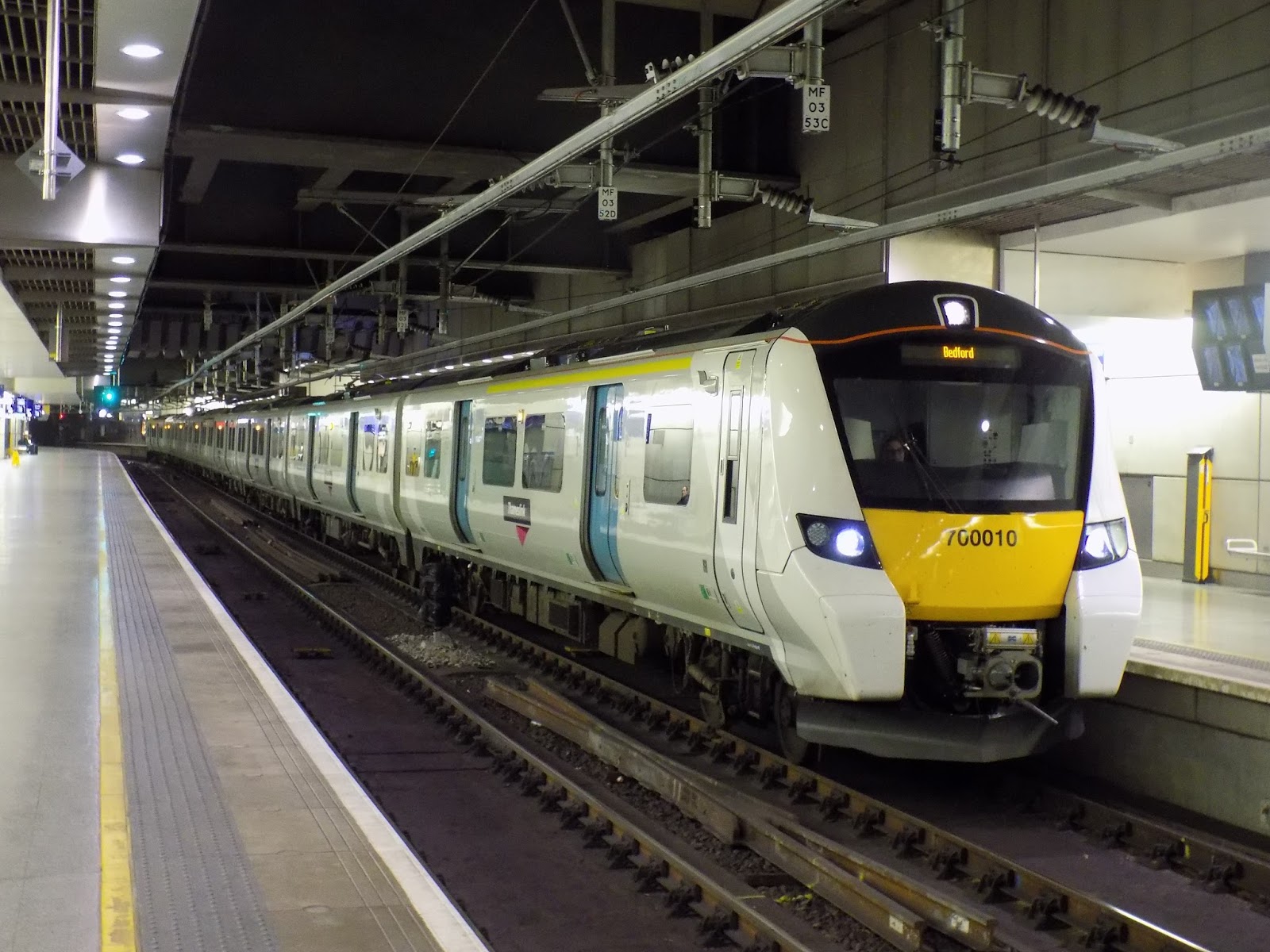
ThamesLink 700010 at London St. Pancras.

If I was to ask you what London rail project is to unveil later this year that has been in the works since the turn of the millennium, chances are you'd say Crossrail (or the Elizabeth line). But how many of you actually said the ThamesLink programme? But why does this project keep being side-stepped, particularly in reference to Crossrail when it's just as big, if not bigger?

Let's talk trains
Due to officially and gradually open later this year, the ThamesLink programme is a massive rail project to connect more towns and cities in the West Anglia and Bedfordshire, through the heart of London and to spawn out the other end in Kent and Sussex in a north to south format. There will be an array of regional commuter and metro trains involved, providing a first time direct link from Cambridge to Brighton and Maidstone, and Luton to Rainham (not our one, the one in Kent) via Bluewater, Dartford and Gravesend.

As a regular traveler on the ThamesLink and Great Northern rail routes, the difference over the last few years is black and white. Although whilst the companies have been constantly named and shamed for their poor reliability and other issues within that field, we have to remember the much more grim days of First Capital Connect. That said, I'm pretty sure that along with sister company Southern, that whole TSGN franchise is up there again for the worst train operating company (TOC) in the country award again by Which? for the 3rd year running.

The stations were often grotty and were slowly falling apart, not maintained well, dirty and lack of staff presence across the network. Now that's flipped around with the grey and pink being dashed out everywhere (and grey and blue, but not as much). But ThamesLink, maybe not Great Northern as much, has come quite a long way and I've always believed that credit does need to be given where its due.


So what is the final result of the ThamesLink programme?
On the internet, the exact answer to that has always been quite difficult to find, especially when it comes to finding out service frequencies and destinations as these keep changing over the years during several consultation periods.

ThamesLink 700018 at Streatham.
From what I've gathered, the services that have always stayed on each consultation period for ThamesLink:

  • The current Bedford to Brighton service via St Pancras, London Blackfriars, London Bridge and Gatwick Airport.
  • The Sevenoaks to London Blackfriars service, also dubbed 'The Cinderella line', will be extended to Kentish Town (or truncated from West Hampstead Thameslink, depends how you see it) for most of the day. It gets a much needed frequency increase to 4 trains per hour. The Orpington service will complement this as well.
  • The Luton to Sutton via Wimbledon 'Metro' service will be cut back to terminate at St. Alban's City. The current St. Alban's City to Sutton via Mitcham will continue to terminate here. 
With Great Northern, through the soon to be opened Canal tunnel from St. Pancras to Finsbury Park, it connects the ThamesLink line and the East Coast Main Line. This will allow trains every few minutes to run through here allowing the direct connection from the Anglia region to Sussex.

Great Northern:
  • The current Peterborough to London King's Cross service will be re-routed to London St. Pancras International, then continues via London Bridge and Redhill to terminate at Horsham.
  • The current Cambridge stopping and semi-fast services to London King's Cross will be re-routed to London St. Pancras International, then continues via London Bridge to either Brighton or Maidstone East*.
  • The King's Lynn to London King's Cross 'fast' services, that run non-stop from Cambridge will not run via the ThamesLink core. It will be one of the few, if only, remaining regular service at London King's Cross during the day**.
  • The Welwyn Garden City Metro service will, during the peak, be extended to Sevenoaks.
*First small print is that this had originally been planned to be two trains an hour to Brighton, and two trains an hour to Tattenham Corner. However, many stakeholders saw this as a waste of resources (the choice was random, even we have to say) and available paths, and decided to send the trains to the much bigger town (and as a destination too), Maidstone East. 

Interestingly, ThamesLink has taken a short-term decision to not run trains beyond Finsbury Park to Maidstone East on Sundays, where trains, as now, will run into London King's Cross at an hourly frequency instead. The Brighton variant of the service will continue to still run through the core.

**The second small print is that it was intended for the ThamesLink programme to make it all the way to King's Lynn. However, due to infrastructure issues, particularly relating to the platform lengths (a few stations on the line can only hold 4-cars) and power supply restrictions that would not be able to handle 8 or 12-car trains, it's put a dead end to what was a promising view for the Fen Line passengers. In the short run anyways, we can only hope.

As a result, the London King's Cross to King's Lynn train will continue to be operated by the class 387 'Electrostar' trains that have just been introduced last year.

Another interesting addition is a brand new route from ThamesLink. As aforementioned, a new metro train service from Luton to Rainham in Kent calling at all stations (it runs fast Mill Hill Broadway to West Hampstead ThamesLink) every half-hour using brand new dual-voltage trains. This service would run through North, Central and South London before making its way out via Bluewater [Greenhithe], Gravesend, Gillingham (Kent, not Dorset - but you should have figured that out by now) before terminating at Rainham. 

This replaces the London Charing Cross to Gillingham semi-fast service currently operated by Southeastern using class 465 Networkers and also the Sutton loop trains north of St. Alban's City. 
Moorgate station, rather grim.

Did we mention it runs at night too?
ThamesLink is one of very few operating companies to run trains throughout the night. The only other ones I can think of whilst writing this is sister company Southern (who withdrew half of their services late last year anyways), Transpennine Express (does this really count when it's once every 3 or so hours?) and the newly introduced night London Overground which only runs weekends. Oh, and of course the Caledonian Sleeper franchise too.

Trains will continue to run hourly, with the option to pursue a half hourly service in the future, calling at all ThamesLink stations between Bedford and London Bridge, followed by East Croydon, Gatwick Airport and Three Bridges.

Give them credit, they were here before the night tube, 7 days a week too.

Improvements to stations
Bar the broken promise with King's Lynn and the Fen Line, all stations will see an improvement in reflection of the fact that their rail services are majorly improving. Some of the flagship work has taken place around the biggest stations in Central London, a headlining one being Network Rail's London Bridge station. Others include the relatively new (2007) London St. Pancras International, London Blackfriars (2012) and City ThamesLink (1990s - but it still looks the part nearly 25 years later). 

The platforms at London Blackfriars station
A futuristic look has been given to them, but when I say that, it's not like the dull metal display that you'd find on the Jubilee line extension. Maybe St. Pancras' is to an extent but otherwise it's a carefully thought, well-designed, light, airy and modern design that even has a reflective vibe surrounding this. I still argue to this day that the renovated London Blackfriars station has to be one of the best stations you can find in London. The shell is mostly made of glass, with the platforms hovering above the River Thames (possibly the only station in the country to do so) spanning the full width of the river. It allows for an undisputed view of London's biggest waterway, bridges and myriads of well identified office buildings and of course the South Bank. 

The grade listed station at Farringdon, together with the London Underground, has had its original engine shed roof from when the Metropolitan Railway first started restored to its former glory. Mass expansion, particularly of the platforms, has allowed for more capacity during the rush hour and when the programme fully opens up (blocking off access to the City Widened lines to Moorgate - that explains the abandoned platforms at Barbican and Moorgate). What's more important is that Farringdon has lately seen an overhaul on the London Underground side, but now the ThamesLink Programme and Elizabeth line are planned to interchange here. In over a year's time you can get a train to Heathrow, Gatwick and Luton Airports from here!

The new entrance at London Bridge.

Part of the station forecourt at London Bridge.

The new London Bridge station had in fact opened another entrance following the New Year's, being the final leg of the station renovation project. Whilst some platforms remain closed until May as no trains will operate from [them], it has adopted an airport style concourse. Yes, it's equipped with gates that have lit arrows and crosses above them to show what gate you can go through and can't. The new arcade as well is quite grand and has quickly caught the attention of enthusiasts and passengers alike, no doubt that Network Rail really took pride in this particular station - the 4th busiest in the whole country.

GONE: Repainted ThamesLink 319444 'City of St. Albans' at Farringdon.
A full fleet of new trains
To help maximise and modernise the extent of this revolutionsed rail network, the Department for Transport (DfT) commissioned for a fleet of 115 brand new dual-voltage electric trains to be ordered. Dual voltage, because the ThamesLink line is one of few unique railways in the UK where trains in passenger service have to switch between overhead lines and third rail to obtain their power at Farringdon.

German manufacturer Siemens had won the contract to do this, building two new depots at Three Bridges in Sussex (that's just south of Gatwick Airport) and Hornsey in North London to station this huge fleet out of. A promise was made to hire more people into the engineering aspect of this company expansion with apprenticeships making up a percentage of their work fleet. 

These new trains are essentially the rivals to the class 345 Aventra trains, were classified as the class 700 Desiro City. This 'variant' of the series - the more appropriate way to put it - was its debut in the United Kingdom based on the success of the much-loved Desiro trains that have been in service since the early 2000s. They come fitted in either 8 or 12 coach fixed formations, walk-through, fully air-conditioned, toilets, charging points and at-seat tables and a first class section. The trains were built in two batches, with the 700/0s being 8-cars and found on the Metro services via Sutton and to Sevenoaks and Orpington, and the new service to Rainham and Maidstone East. They are currently found during the day working the Bedford to Brighton route as well however this won't be the case as much when the programme is in full swing, as this line, alongside Cambridge to Brighton will use the 12-car trains. 

ThamesLink 377510 in repainted neutral purple and sporting the
newer ThamesLink/ logo at Farringdon.
[These] replace the 30 year old class 319 trains that were withdrawn last summer from ThamesLink, which came in a 4-car formation. Enthusiasts find this particular class to be like marmite, either you love it or you hate it, so their farewell saw mixed reviews. It's not just the 319s they replace though, they also replace the class 377 'Electrostar' trains built by Bombardier as these move to Kent and work with Southeastern on their mainline routes as part of an enhancement programme. 

The first of the two depots to be opened was Three Bridges, and subsequently the first train was sent there and in early summer 2016, the first class 700 started service after a public exhibition to showcase the new design to the public was unveiled months earlier, 12-car 700108 ran a service from Brighton to London Bridge. Subsequently, after few teething issues, more quickly entered service and within about a year the whole ThamesLink fleet had been converted to class 700s including on the Metro services.

Passengers praise the trains for their more comfortable seats in comparison to the Aventra ones. The 700 is a train with more facilities doing the same distance as a typical Crossrail train on a Metro service. The passenger information system (PIS) has been noted for temporarily fuzzing out and being out of sync from time to time, however it tells you how busy the train is, live tube updates, the status of the toilets, safety notices and the calling pattern of the train. 

The displaced class 319s have now either gone to storage, or are being converted into class 769 Flex bi-mode trains for use up north on partially electrified lines (similar to the class 230 D train from our old D-stock). Some 319s are also getting a new lease of life as increasing more and more are coming to new operator London Northwestern Railway (West Midlands Trains) to enhance capacity on the southern stretch of the West Coast Main Line between Northampton and London Euston, particularly when a new, revised and higher frequency timetable is introduced this December.

Brand new 700031 at London St. Pancras.

ThamesLink to Horsham and Littlehampton
In the last timetable change during December 2017, ThamesLink took over, using class 700s, some of Southern's diagrams from London Bridge to Horsham via Redhill and to Littlehampton, a spur off the West Coastway line.

Two trains, via Redhill, runs approximately every 60-90 minutes all day Monday to Fridays between London Bridge and Horsham as ThamesLink. This allows for a smoother transition when this service becomes more high frequency and is extended to Peterborough via Finsbury Park. 

The service to Littlehampton runs just twice a weekday under the ThamesLink flag in each direction in the peak direction of travel. Majority of services, and all stations continue to be operated by Southern. 

Some trains are currently stored on the East Coastway as well down at Eastbourne, providing a useful berthing facility overnight.

The Northern City line to Moorgate
A separate line to the rest of the programme but happens to be getting its upgrade right now and does interwork its way into this, as it's operated by Great Northern. There are two lines right now, from Moorgate to Welwyn Garden City and Moorgate to Letchworth Garden City via Hertford North. Majority of trains terminate at Hertford North.

Great Northern 313123 at Finsbury Park bound for Moorgate.
However, due to the sheer intensity of the ThamesLink programme, track and capacity space is being utilised to its breaking point around the Stevenage area and a proposal set forward to relieve this issue is to cut the Letchworth services back to Watton-at-Stone and provide a reverse enabling facility (i.e. crossover). A bus would then run the rail replacement service until further notice between Watton-at-Stone and Stevenage where passengers can connect to rail transport once again. 

More capacity is being provided with an additional 30 Siemens Desiro City trains being ordered for the Moorgate services, all of them to a fixed six-car length and of similar design. However, they will be equipped with cab door exits in the event of an emergency in the Moorgate tunnels and will be standard class throughout. These will also be stationed at Hornsey. These variants are called the class 717s and will mainly be confined to this line replacing the class 313s, the oldest EMU mainline trains still in service. 

The ThamesLink, Northern City and Northern lines
An interesting conflict arose this week between ThamesLink, the press and Transport for London (TfL) for not showing or advertising the ThamesLink programme throughout the duration of the works, or displaying this on pocket tube maps. Several parties who had commented on the matter stated that it was 'secretly' in interest to protect their revenue, which had been falling over the last year, and did not want to lose London based competition to a rival company, even though ThamesLink is considered the second 'Northern line' essentially. It does go from Tooting to Mill Hill, though.

So far, this is the story of a Cinderella line. After billions of investment, and station upgrades, new trains and better connectivity, this one ugly duckling will be sure to turn heads when it rolls out later this year.

We would like to send a huge thanks to all our half a million and counting readers who have kept the blog alive for the last 5 years to this day! 

And now that you've read this post, why not visit the amazing London Buses: On The Go who also turned 5 today!