• The Bakerloop

    Read all about TfL's latest Superloop route here!

  • The Electric Takeover

    Keep up with all the electric buses with London Connected!

  • About Us!

    Get to know the team who have been fuelling the blogging community for 10 years.

  • Service changes

    Keep up-to-date with the Tenders page or visit us on Flickr for additional content.

  • Back On Track

    Expanding our coverage from the bus scene to the rail network.

  • Busy Bus Buzz

    Everyone's welcome to join and share their opinions on London's transport scene. All the news, views and more daily on our chatbox. Powered by Chatango

Romford and Rainham go Loopy


The original Superloop allowed for a circle of routes around London, but notably quite a few areas were missed out, Havering was a notable area with the Superloop not venturing that far out east initially. Sadiq Khan's re-election saw a promise to expand the Superloop and giving Havering a Superloop route was a high priority. After consideration, TfL decided to introduce route SL12 to cater for their needs. 

Initially proposed to run between Rainham South and Leytonstone, the final proposal saw the route proposed to run between Rainham, Ferry Lane South and Gants Hill Station running express via Cherry Tree Lane, Elm Park Station, Queen's Hospital, Romford Town Centre, Marks Gate, Little Heath and Gants Hill. Effectively following routes 165, 252 and 66. The first day of operation was the 5th of September after seeing an initial delay from a proposed Spring 2026 start date. Stagecoach London successfully won the route out of Rainham (RM) garage which the route goes past. 

In the weeks leading up to the route's introduction new stops appeared in the Ferry Lane Industrial area, and in the days leading up to the introduction small changes started to be made in anticipation of this route's introduction. I did venture out to ride it on its first day, but being awash with enthusiasts left right and centre, of which a decent number of them did not have any social skills leading to banners being placed on bus windows and rushes for front seats on a bus in a desperate attempt to film visuals, giving little care in the world as to whether members of the public genuinely wanted to use the new route in peace. I eventually decided that it wasn't a great idea to try and get a taste for the route on day 1 and that I would return later. However I still managed to get a good dose of TfL mismanagement for its introduction.

It turned out that TfL had completely messed up the iBus for the route, with incorrect announcements being played. The iBus showed Romford Station as the destination towards Gants Hill, while every single route that terminated at Leytonstone had its announcement changed to Rainham, Ferry Lane. It was not a great start when you have completely wrong publicity for a new route. The last stop at Gants Hill also had its flag completely mangled by whoever put up the new SL12 tile, with the new tile placed below the old 'Superloop' banner on the flag that was already there for the SL2, and also having a 'school buses stop here' tile between the SL2 and SL12 tiles as well which is just completely wrong, at least they got the information about it being an slighting point correct! 

What has to be said though is that all the buses were very smartly presented from day 1, which cannot be said for other Superloop introductions throughout London. Although with the amount of time Stagecoach had to prepare for this takeover, you would hope that it went smoothly from their side! Interestingly route SL12 is also the first Superloop route to use Wright Electroliners as an allocation, with the other routes using ADL or BYD bodied vehicles. 

I went back out to ride the route a week later, in hopes that it would be a more bearable ride without misbehaviour on board. We had a few people board throughout the route from Rainham to Romford, although due to the roads the route uses it was proving hard for our driver to overtake a 365 which had crept in front of us at Cherry Tree Lane. Luckily there was some room just before Elm Park Station where the driver went in for the overtake and it then wasn't long until we managed to reach Queens Hospital. Most of our passengers alighted at Romford, as did I to go to pop to the shops to grab a quick snack. I then got on another SL12, although notably in this case a 66 had arrived just before this SL12. That would be the last I saw of the 66 though as that would then storm ahead of us while we regulated and we were not going to catch up. We didn't pick up much passengers from Romford onwards, my guess would be that the 66 ahead was hoovering up passengers, should there have been any. 


We eventually arrived at Gants Hill and everyone remaining on the bus got off while the route went off to a bus stand on Perth Road. 


The introduction of this route arguably raises more questions than it answers. The glaringly obvious one is whether anyone along the 66 or 165 routes were even asking for an express alternative, especially on a route like the 66 which is fast enough as it is. Route 165 had also just recently undergone a double decker conversion increasing capacity considerably on the Cherry Tree Lane corridor, especially at a time when TfL are busy cutting routes both in terms of frequency and in terms of route length. I have always advocated for brand new express routes where necessary, but it's increasingly obvious that this was a political tick box exercise of a route as opposed to one where genuine thought had gone into the route's development and introduction. I have to say that if I were a regular user of the 66, 165 or 365 I would be quite fearful of an impending cut to frequencies. 


Route SL12, while a debatable introduction forms part of the direction TfL are continuing to go in. Two more Superloop routes have been confirmed for introduction. Route SL14 running between Stratford and Chingford Hatch and route SL15 running between Eltham and Clapham Junction. Route SL13, currently proposed to run between Hendon and Ealing is yet to get the green light, however TfL have said that we are likely to know whether it's going ahead soon. But in the meantime, we've all got a new bus route to ride!

All photos are © EastLondoner, please click on them to view them in higher quality 

A New Face, and an Old One

Lately there have been two routes who have changed operator in South-East London. One of these is route 301 which runs between Woolwich and Bexleyheath and another is route 208 which runs between Lewisham and Orpington, Perry Hall Road. Both routes have been taken over by Stagecoach London.


Starting on route 301, this is a relatively new route which only commenced operation in 2019, introduced as part of an improvement to buses in the Woolwich area with the impending introduction of the Elizabeth Line. We wrote a post on this route when it was initially introduced, it's amazing how time flies! Over the years the route grew in popularity, establishing itself as a vital link between the Bexleyheath area and Abbey Wood, and has since also become the only route serving Nathan Way since the withdrawal of route 472. The route remained with Arriva out of Dartford (DT) throughout the contract, although its allocation did silently switch to Volvo B5LH buses and Enviro400s would also occasionally make appearances. 


It was announced on tender that the route would pass to Stagecoach London in July 2026 using brand new electric buses, it was going to operate out of Plumstead (PD) with new electric buses introduced, some good news for the garage coming off the back of the 96 and 472 losses. New Wright Electroliner buses were ordered for it, but a decision was taken to send some nearly new Enviro400 EV buses which had been introduced at Bromley to operate on the route instead. This was because route SL3 was also going to be moving to Plumstead off the back of the 208 win and a decision was taken to keep all of Stagecoach's Enviro400 EV vehicles together. This led to Stagecoach's first day being a majority electric operation due to the fact the buses were already well run into the fleet. 


I took a ride on the 301 around two weeks after Stagecoach had taken over operation of the route. It's quite safe to say that they had bed into the route quite well, although not too shocking as Superloop route SL3 parallels the route for certain portions and Stagecoach also operate other routes in the area which deal with similar traffic conditions. While the 301 is allocated Enviro400 EV vehicles, other vehicles are also liable to appear on it such as the variety of Enviro400 MMCs that Plumstead garage have, these have been reblinded so that they can appear on the route when required. Some spare Wright Electroliners have also been brought into the garage to run on the route, but unfortunately I don't have a picture of these to hand. 

When I wrote about the introduction of this route 7 years ago, I mentioned that it was hard to write about such a new route. 7 years later I still find myself in the same position, with the argument there's even less to write about this route as barely anything has happened regarding it. Although for a commuter that is probably the best news you can have, no needless tinkering and alteration of the route, it's a good example of a route that's worked well since its introduction and fulfilled its purpose. 


This brings us nicely onto the second change that this post covers, and that's route 208 which has moved over from Go Ahead operation to Stagecoach operation. Route 208 has got a much more colourful history than route 301, starting operation in 1982 and operation of it being shared with Stagecoach and its predecesors between Bromley (TB) and Catford (TL) garages until Go Ahead took over its operation in 2019. Funnily enough we also covered that change on the blog 7 years ago. Although alas Go Ahead's tenure was due to be the 7 year contract and nothing more as Stagecoach won it back when the route was up for tender again. Go Ahead ran the route using Enviro400 MMC hybrid buses, although in the later years electric buses would often show up on the route, but you'll have to forgive me as the LED blind wasn't playing ball with my camera on the day I took the below picture!


Stagecoach had won back the 208 out of Bromley (TB) garage with brand new electric double decker buses. Although to make space for the route, route SL3 had a move to Plumstead (PD) planned. A delay in increasing the number of chargers at Plumstead garage meant that the SL3 couldn't move over in time for the 208s new contract and therefore the decision was taken to start off route 208s new tenure at Stagecoach at Catford (TL) using existing Smart Hybrids which had been made free from routes 261 and 372. Route 208 would then move to Bromley garage at a later date when Plumstead was in a position to start running route SL3. Brand new Electroliners are already on order for route 208 and will be introduced upon the route's move to Bromley.

Stagecoach did not hesitate to welcome the route back in style, with two special liveried buses put out into service. One of which was the Selkent Diplomat which was specially liveried to celebrate 100 years of Bromley Bus Garage, it's ironic that it's now running out of Catford garage, but is very suitably found on the 208 which as a very long association with Bromley garage. 


When I rode the 208, it was its first day back with Stagecoach and many esteemed enthusiasts will know that the first day an operator runs a route rarely sets the standard you can expect the operator to perform at and the 208 was no different. A few traffic issues and road closures south of Bromley meant that there was some displaced traffic to deal with and buses were frequently turning short at Bromley and Orpington War Memorial, although I can quite confidently say that the service will improve over the coming weeks and who knows...maybe it will be like the 208 never left in the first place. 

All photos in this post are © EastLondoner

One, Two, Three. Go Ahead!

Route 123 runs between Ilford in the depths of East London all the way to Wood Green in the heart of North London, being the only major route in the area to provide this important link running via places such as Gants Hill, Walthamstow, Tottenham Hale, Tottenham High Road, Turnpike Lane and Wood Green. 


Go Ahead London have just taken over operation of this route from Arriva, who had operated the route since 2005. The route has a pretty colourful history with them and over the years grew to be a staple route. They took over operation of the route in 2005 from First Capital who had operated the route out of their Rainham (R) base, which was considerably off route in comparison to Tottenham (AR) which was the garage who won it. They introduced brand new ALX400 bodied Volvo B7TLs which became synonymous with the route in the years which followed. The route remained at Tottenham garage for nearly 10 years until a closure of Lea Valley (LV) saw a huge reshuffle take place within Arriva and route 123 was moved to Edmonton (EC), although retained a Tottenham  garage allocation on the weekends. 2016 saw the entire route returned to Tottenham garage where it then remained until the end of the Arriva contract. 


The Arriva allocation was predominantly VLAs, however these fell out of favour towards the end of Arriva's second contract on the route and were replaced by Volvo B9TLs which were brought in from Tower Transit. These then got replaced by DW class buses when the route was fully moved back to Tottenham garage in 2016.


During this time, Wright Eclipse Gemini 3 vehicles also became a mainstay on the route, and in some cases making up the bulk of the allocation. 


In 2025 it was announced in a tender result that Go Ahead London had won the contract to operate the route from their Northumberland Park (NP) garage which is just a few minutes drive from Tottenham Hale where the route ran. No doubt this came as a big upset to enthusiasts who had grown used to the Arriva operation, but nonetheless a surprise as Arriva had not been the cheapest bidder on the 123 since their initial win in 2004. 

The 28th of February saw Go Ahead take over operating the route starting with the 123s midnight service. Although a miscommunication on Arriva's part saw Arriva also run the night service alongside Go Ahead so you had the unique situation where two operators were running a route. Notably this is the second time Arriva have done this on a route in just a few years with a similar fiasco unfolding when they lost the 242 to Stagecoach and the N242 service was operated by them when they shouldn't have been operating it. The next day saw a mixed fleet of buses from Go Ahead running on the route. The allocation included MCV EvoSeti bodied Volvo B5LH buses, Wright Eclipse Gemini 3 bodied Volvo B5LH buses, Enviro400 MMC bodied Volvo B5LH buses and both diesel and hybrid versions of Wright Eclipse Gemini 2 buses. 


The first day was rocky to say the least, with hour gaps being present at Ilford and buses running around in huge groups, although Arriva rarely covered themselves in glory on this route often also having large gaps and buses frequently turning short throughout the route. Go Ahead however have a three year contract ahead of them so hopefully the route will improve under them and provide a reliable service!


It's certainly going to take some time getting used to seeing Go Ahead operating on this route, however London's largest operator continues to grow from strength to strength!

The Feeder Loop

TfL have made another addition to the Superloop network, this time coming in the form of new route SL11 running between North Greenwich Station and Abbey Wood Station


The introduction of the SL11 is the first Superloop introduction which has included the direct removal of a parallel all stops service. While other Superloop routes such as the SL7, SL6 and SL8 have all seen renumberings of existing express routes, the routes themselves were left completely unchanged. Route 472 however, is now no more. But why was the 472 withdrawn? 


Route 472 was introduced in 1999, around the time the Jubilee Line was extended to Stratford via North Greenwich, providing the borough of Greenwich with its first London Underground link, while simultaneously providing a bus link to the newly opened Millennium Dome (today's O2 arena) while running through to Thamesmead. Over the years a growing population of people at Thamesmead, alongside a lot of new house building in the Woolwich and the Greenwich Peninsula area had seen demand for the 472 shoot up as it was a fast and frequent route linking these areas to their nearest stations. The opening of the Elizabeth Line saw the 472 rerouted to also serve Abbey Wood, adding another station to its portfolio. The demand for the 472 continued to grow and eventually it was decided that the 472 would become part of the Superloop network, providing an even faster link from dense housing areas to the stations in the area. The night service on the route was to be spun off as new route N472 instead. 

Route SL11 (and N472) in what could arguably be classed as major tendering upset saw the contract awarded to Go Ahead London, as opposed to Stagecoach London who had operated the 472 throughout its operational life. The route was to be run out of a new base in Thamesmead, however a pending planning application means that the SL11 is temporarily being operated out of Morden Wharf (MG) in the meantime. When the route moves to Thamesmead brand new electric buses are going to be introduced, but in the meantime the route is currently using a mix of New Routemasters that were previously on the SL3 alongside some Volvo B9TLs that Go Ahead have brought together from the rest of their fleet. 


The route was initially meant to have a full New Routemaster allocation, however extreme unreliability alongside the batch of buses being sat idle ever since they were relieved off their SL3 duties meant quite a few buses had issues passing their MOTs. While these are being rectified the Volvo B9TL buses are filling in, with themselves having been made free from electric conversions elsewhere in the company. For this reason the Volvos are also not branded with Superloop livery and are in plain red, something you don't frequently see on Superloop routes. 

I went to have a ride on the SL11 shortly after its introduction. For some bizarre reason before even boarding the bus I noticed that the stop sign at North Greenwich Bus Station did not have the SL11 on its tiles inside, although they were present on the flag. A New Routemaster showed up, complete with branding both inside and outside, including maps for the SL11 and even the N472 in a first for a night route. 


The route runs express, with some stops in the Greenwich Peninsula before heading non-stop to Woolwich and then running express through Thamesmead before reaching Abbey Wood. An interesting anomaly though is the SL11 shares a small parallel with the SL3, where the SL3 runs non stop past Linton Mead Primary School but the SL11 stops, so could be the only example in London where one Superloop stops but another one goes past express. We did have a few passengers on board who boarded in the Thamesmead area under the assumption this was an SL3 (we even had one person board thinking the route was a 301) and then stormed the driver with questions when we reached our last stop at Abbey Wood.


There is not much else to say about this route, it's effectively a 472 replacement that runs express. It's certainly going to be of huge use to the residents that live along the route that need to get to North Greenwich, Woolwich or Abbey Wood stations in decent time. Whether it will stimulate more growth on the route remains to be seen.

Superloop will continue to grow, with the SL12 being the next route to be introduced between Rainham and Gants Hill later this year!

The Bakerloop

 TfL's financial status these days is no secret, with increasingly constrained budgets and a reduction in money coming in over the past few years there is a real challenge to ensure that TfL continue to have enough money to stay afloat and provide to the transport needs of the average Londoner. 


Today's post focuses on the Bakerloop, the latest route addition to TfL's network of buses that operate in the capital. The route is called the BL1, running between Waterloo and Lewisham.

But why is this called the Bakerloop? Why not just another standard Superloop route? Well this story runs a lot deeper. This starts with the Bakerloo Line, the Underground line running between Harrow & Wealdstone and Elephant & Castle, identified by the brown colour on the tube map. It currently operates with 1972 stock and its stations and the entire line itself has grown famous among Londoners for its somewhat unique state of care. Some people like the fact it's a time capsule, although many people also do not like the fact that the line still looks like it was last touched in 1972, especially when you've had lines like the Elizabeth Line open since then which are effectively an entire world away. The line is also a relatively short one, only starting in Zone 1 at Elephant & castle as opposed to running through Zone 1 and out of the other end. This has made it a prime target for an extension. It is well known that in the UK if you build an infrastructure project then it rapidly gains popularity. The Elizabeth Line and Northern Line extensions are prime examples of this, so an extension of the Bakerloo Line has been proposed from Elephant & Castle to Lewisham. Although TfL's funding constraints mean that this is not something currently funded but merely exists as an idea. 

TfL is likely going to need to find such funding somewhere, but in the meantime there was no reason that the links could not be started by bus! The Superloop network had proven the concept of express bus routes over the past year and a Lewisham to Waterloo service to link with the Bakerloo Line was effectively a no brainer, so much so that Mayor of London Sadiq Khan turned this into a manifesto pledge. Following a successful 2024 election campaign the new proposed route was put up for tender and Go Ahead were the successful bidder with the BL1 to start operation out of Waterloo (RA) garage. The route was to start on the 27th of September 2025 running express between Lewisham and Waterloo Station.

The buses were going to bear a livery similar to the one already seen on existing Superloop routes, although some livery inspirations were also drawn from the Bakerloo line and its existing identity. Go Ahead had won the contract using existing buses, so these were cascaded down from Northumberland Park's (NP) route 230 which had got a newer batch of electrics which allowed its older batch to go off and get refurbished for the BL1. This refurbishment saw them fitted with brand new LED destination displays replacing the old roller blinds that the buses used to have. The existing Go Ahead London moquette was also removed and replaced with two variations of the 'Barman' moquette which is found across multiple London Underground lines. One of them is identical to the seating moquette found on the Bakerloo Line's 1972 stock trains, but the priority seats have a blue variation of these to help them stand out to passengers indicating their difference. 


Publicity has also been put up at all stops on the Bakerloop route network. This is very similar to the existing Superloop branding at stops, although instead of a route tile on the stops in red, they are brown to lean into the existing Bakerloo Line brown theme. As the route is still a part of the Superloop network, the route is limited stop many stops are skipped on the route, with passengers travelling between these stops expected to take routes like the 21, 53 and 453. The stops served include Lewisham Centre, Lewisham Clock Tower, Lewisham Station, New Cross Gate Station, Old Kent Road/Ilderton Road, Burgess Park/Dunton Road, Elephant & Castle and Waterloo Station.

Initial impressions of the route show an already growing user base, with passengers using the faster links that this route provides. The route itself doesn't do anything new apart from a link to Waterloo that Lewisham previously never had by bus, but already had by train. Although I have to admit my favourite part of the route is using the Bricklayer's Arms flyover to avoid all the traffic down below and seeing the roundabout below you, alongside the added benefit that you don't have to wait in any of it! The route otherwise is unremarkable, just plodding up and down the Old Kent Road, but its existence is a testament to how faster journeys can attract users from an already established user base, new links don't always need to be provided but existing ones being improved will always be welcomed by everyone!


There is another phase of Superloop routes currently being consulted for, with two routes the SL11 and SL12 already confirmed with Go Ahead and Stagecoach taking these on respectively. Unfortunately life gets in the way which has limited our ability to post lately, but please ensure that you keep an eye on the 'Tenders' page on the blog which gets updated regularly and remains up to date. 

Do you want to see more 'Bakerloop' style routes? Where potentially extended rail lines instead get turned into express bus routes? Let us know in the comments section what you would like to see introduced next!

The Stagecoach Liners

As electric buses start to enter London tick and fast, Stagecoach are part way through introducing a large batch of Wright Electroliners onto routes 86 and 199 out of North Street (NS), Lea Interchange (LI) and Catford (TL) garages. 


It's certainly been a long time coming for these buses and their entry into service, with the tender award for route 199 being in October 2022 and the tender award for the 86 being in November 2022. While we knew that brand new electrics were on the way for the retains, Stagecoach and other sources remained tight lipped for a few months until it was announced that both routes would be recipients of Stagecoach's first batch of Wright Electroliners, a departure from Stagecoach's usual orders from Alexander Dennis, but notably not their first order from Wright as they had previously placed an order for route 53


These buses were to be the first for Stagecoach that were going to be specified to 'high spec', and Stagecoach were also the last major operator which were to introduce the new spec. The buses were spotted on delivery towards the end of summer 2023 before eagle eyed enthusiasts noticed that the standard Stagecoach interior was not present on these buses, followed by the revelation that the interior present on the buses wasn't a Stagecoach themed interior at all but was actually the TfL specified interior that had been seen on Sullivan Buses, CT Plus' buses and Arriva's E40H Citys. Did this signify the end of the famous and much loved Beach Ball interior? Quite possibly. These buses were unique in being the only batch of buses in London specified to the new specification interior, but having blinds on the front of the buses as opposed to LED displays. 


I went out in November shortly after the buses made their debut on the 199 to take a ride on the vehicles to get an impression for them. Following a very long wait due to a protest in Lewisham an Electroliner eventually turned up and I made myself comfortable on the upper deck. The new specification for buses require a digital LCD screen displaying next stop information on both decks. TfL have a standard format that they use across all routes but it needs to be programmed. When I rode the bus Stagecoach and/or TfL had not managed to do this yet and the next stop information was being displayed on the standard McKenna Brothers software, which actually isn't much use as it can only display the final destination and not the next stop information. Thankfully this problem has since been fixed and the next stop is now displayed in the standard TfL format alongside the final destination on all routes that these buses operate. The floors on the vehicle are a wood effect -  laminated flooring and not actual wood and the seats have leather headrests with priority seats having a 'Priority seat' sign on them so that passengers know whether they are sitting in one or not. The new bus specification also required a rear facing iBus display so that passengers in the wheelchair area can see the next stop information without needing to turn around, although on Stagecoach's vehicles these are to a slightly lower quality than the forward facing screens. 


The rear facing display has the slightly annoying quirk of not being centred, and the righting is slightly offset towards the right. The display also does not have the ability to scroll text (yet), which means longer destinations and stops often get cut off. I would imagine this will get solved in a future software update, but at the time of writing this post that is yet to happen. The buses also have the standard bells and whistles of USB charging points and up lighters on the stairs. 


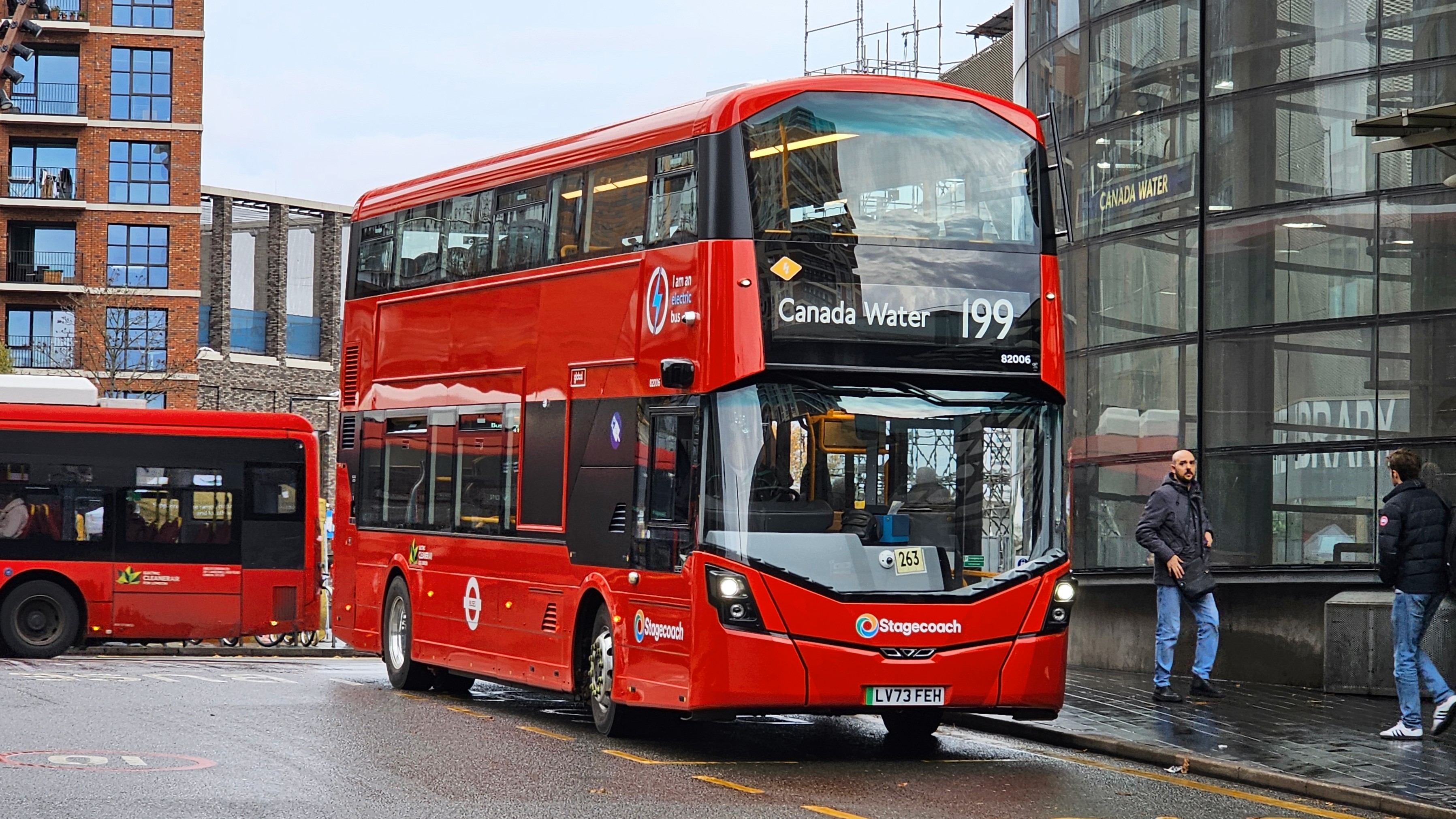
82006 seen at Canada Water Bus Station

As I alluded to earlier in the post, the 199 and 86s batches of buses were ordered as one big batch. With the 199 getting the earlier buses (82001-82014) and the 86 taking the later buses (82015-82048). The batch for the 86 suffered a bigger delay with getting into service due to Romford garage (NS) facing delays with its electrification and the introduction of a partial allocation at Lea Interchange (LI) as well to ensure that all the buses could be accommodated. It wasn't until 2024 that buses started entering service on the 86. While I'm writing this post, the full batch of buses is still yet to enter service on the 86 and it's a really slow process due to the various restrictions at the garages that the route is running from. The buses otherwise are identical to the batch that is found on the 199. 


Old and new at Ilford, 19807 and 82025

82045 seen at Stratford Bus Station


While these were Stagecoach's first order for Wright Electroliners, they certainly aren't the last. A second batch of Electroliners is currently in the process of delivery for the recent acquisition of route 242 from Arriva, this newer batch have even more features such as a sky light and LED destination blinds. Alongside this there are also brand new MCV bodied Volvo BZL single decker buses arriving for routes 276 and 314, some new MCV bodied Volvo BZL double decker buses for routes D7, 58 and 277 and Switch MetroCity EV buses arriving for route W11. There are certainly exciting times ahead for the company!


All photos used in this post are © EastLondoner and may not be reproduced without permission. Please email LondonTransportConnected @gmail.com for photo use queries