• The Bakerloop

    Read all about TfL's latest Superloop route here!

  • The Electric Takeover

    Keep up with all the electric buses with London Connected!

  • About Us!

    Get to know the team who have been fuelling the blogging community for 10 years.

  • Service changes

    Keep up-to-date with the Tenders page or visit us on Flickr for additional content.

  • Back On Track

    Expanding our coverage from the bus scene to the rail network.

  • Busy Bus Buzz

    Everyone's welcome to join and share their opinions on London's transport scene. All the news, views and more daily on our chatbox. Powered by Chatango

Showing posts with label Post with Jacob. Show all posts

Taking you through the years: 2013

We've been around for about 7 years and a bit now...and counting. It's been a rough start to the year for the world because of that c-word so how about something to lift those spirits by strolling down, past the better times, to Memory Lane.

Phwoar, remember this!
First London TN33191 on route 607
2013
The way buses look has really changed
The year was 2013 back when we started, right at the beginning of it. The country was still on cloud nine following what was a rather successful 2012 Olympic, which London itself was proud to host for the third time. Times were different then in the transport industry, several bus routes were still around that aren't now, and likewise, a number of bus routes didn't exist at the time.

A massive difference which I am sure you will remember is also the fact that transport giant First operated a good chunk of bus routes in London, having built a massive empire particularly across West London. The shock that came to many of us that all of this was to be sold practically overnight on the 22nd June.

On the left is a type we sadly no longer have in London anymore, quite literally the President of buses. A Plaxton President bodied Dennis Trident 2 operating limited stop route 607 - since this photo was taken, the route had been upgraded to a mixture of Wright Eclipse Gemini 1 buses and Alexander Dennis Enviro 400s shortly after. What's more shocking (where has the time gone?!) is that the route has now been upgraded once again to new MCV Evoseti bodied Volvo B5LHs.

This is a prime example of how much even the specification of buses has changed since the 2000s. London buses are not allowed to have operator logos or decals either side of the destination display as shown here, something First were well known for doing.

TP411 (LK03 CFE) on route E2 in Northfields
Something else that has massively changed is the mass-disappearance of skirts on all TfL buses. It perhaps could be viewed as a shame and a loss of colour across London's busy roads, only to be done in favour of a uniform 100% corporate red on all new and refurbished buses regardless of operator. In 2020 we have very few buses left with skirts, notably the odd older-generation Go-Ahead London bus but it may be very likely that after this year we will have reached a state where every bus is fully red.

Demonstrating what it is that we're talking about, is TP411, now long since withdrawn, a Plaxton President bodied Dennis Trident 2 with the famous Metroline blue skirt and white band and the original logo with the orange stripes through the 't' (it's the little things!) on route E2 in Northfields. The last of these types were replaced by more Wright Eclipse Gemini 2 buses around 2015-2016.


Some routes have really changed operators countless times...

Route 266, between Brent Cross and Hammersmith (or so it was at the time!), has changed countless times in the last 7 years. When we started in January 2013, the route had only been settling in at it's new home, Atlas Road (AS) (remember that?!) under a shock tender win when First had nabbed the route in May 2012. The route was to use a mixture of new and existing (but even they were only a few months old) Wright Eclipse Gemini 2 bodied Volvo B9TLs that were in use on flagship route 23 at Westbourne Park (X) garage.

The route has changed a lot since then and we'll probably see it again later in this series of commemorative posts but only in brief. But to sum up all the changes, Atlas Road (AS) had been purchased by then-new Australian bus operator Transit Systems, who would trade in London as Tower Transit. This would be the deal for the remaining 4 years of the contract until Metroline nabbed the route back from Cricklewood (W) garage in 2017 using 10-year old Enviro 400s - the exact same ones that had operated the route 2007-2012.

Photography skills were not great at the time - but here is VN36292
at Horn Lane in Acton back in January 2013. This bus has since been withdrawn
from TfL service and now lives in Bath with an independent bus operator.

This was a short-term special contract that was only to last 2 years as the network of buses across West London was to be massively redesigned in the anticipation that Elizabeth line services would start in 2019. However, as we know how that story ended, the £15bn railway had gained a new name, the £18bn railway and was delayed into the early 2020s and depending on the impacts of this virus, it is nearly definitely to be delayed again as construction work has ground to a halt.

Despite all of this, TfL still pushed ahead with the planned bus network changes and so on the 7th December 2019, route 266 was cut so that it only ran between Brent Cross and Acton, Old Town Hall. The section between Acton and Hammersmith would continue to be served at night by a newly created N266, and during the day by new single decker route 218 (Tower Transit, North Acton to Hammersmith) and double decker route 306 (RATP Group, Acton Vale to Fulham, Sands End). The new contract was also timed to start on this day, which saw Metroline lose the route again to RATP Group using a mixture of existing diesel and hybrid vehicles from the 81 and 94.

As a bit of trivia, is route 266 the route that has changed operator the most in the last 10 years? Let us know in the comments if you find another route that can beat this.

WVL417 (LX11 CWZ) on route 425 at Stratford

Route 425 is another route that will have changed operators a couple of times. When we first started, Go-Ahead London had been operating the route from their Docklands Buses base in Silvertown (SI) using a mixture of Gemini 2 and Scania OmniCity buses. The route was introduced in 2008 as a successor to route S2 (Stratford - Bow - Clapton) and was a local service running about every 12 minutes between Stratford, Bus Station and Clapton, Nightingale Road.

First had won the route upon tender in 2013 with brand new Enviro 400 buses. However this may be one of the more weirder tender wins in the history book, as First had submitted the bid in 2012 and had won the route from Lea Interchange (LI) garage for a contract starting August 2013. But as they were keen to sell up and move away from the London bus scene quickly, the depot had been sold to Transit Systems by the end of June that year. This meant that along with all the assets they took over, the 425 contract automatically had been novated, with Tower Transit using the buses First had procured (in their livery and interior fit out too) using the same contract terms and obligations that First had won the route on. So despite winning the route, First never actually operated the route even for a day.

Fast forward several years later to 2018 and an interesting turn of events occurred. Route 425 had been chosen to be extended from Stratford, Bus Station along the A118 Romford Road to Ilford (paralleling routes 25 and 86) in a bid to boost capacity and connectivity but also merge the route with the short journeys route 25 had to Mile End. This saw Gemini 2 buses return to the 425 as a part of the allocation as the route became a high profile trunk route.

Later this year, the route alongside sister route 25 will start a new contract at Stagecoach from Bow (BW) garage with brand new buses. The contract start date may be liable to change. If this does happen, our tenders page will be immediately altered to reflect this.

There's a lot to get through in 2013, and we're a big believer in a picture paints a thousand words so for the rest of this post, here's some photos that sum up the bus scene 7 years ago.

Route 207 was host to a unique (and well missed!) batch of Scania OmniCities. These were the last production batch built for London and the only ones that First had ordered, to enable the double decking of route 207 from articulated bendy bus operation. First wanted to order Wright Eclipse Gemini 2 or Enviro 400 buses however given that the book orders were full up with Olympic 2012 deliveries, they decided to sample Scania buses instead. These have since been withdrawn and some can be found with Ipswich Buses. Route 207 is now operated by Abellio London after Metroline lost it in April 2019.

Route 185 was awarded to London Easylink in 2001 using 20 Plaxton President bodied Volvo B7TLs - numbered VP1-20 from a garage just off the Old Kent Road. This was short lived as just over a year later, the company goes into liquidation. East Thames Buses, the arms-length company owned by TfL, took over the failed routes from their depot in Belvedere (BV) alongside a few others as this happened. In 2009, ETB was sold off to Go-Ahead London along with the routes, buses and staff and ever since, the 185 has operated from Camberwell (Q) garage. The VPs interestingly were never re-classed as PVLs, but the buses were given a charcoal skirt and Go-Ahead logos until their withdrawal a few days after this photo was taken. Route 185 uses newer hybrid buses.

SLE34 (YN55 NKC) is seen on Oxford Street on a wet day in late May, 2013. This was back when
Transdev's London operations had not been purchased by RATP Group. The same summer would see their flagship route 13 from Edgware (BT) garage be upgraded to Wright Eclipse Gemini 2 bodied Volvo B5LH buses (VHs) - with reg plates of the buses even altered affectionately to have 'BT13' as the first 4 digits. The OmniDekkas were then moved to route 292 to displace older Plaxton President buses. As for the 13...the route was withdrawn in 2017 (Golders Green to Aldwych) and replaced by an extended 113 and 139. Overnight also saw route 82 (North Finchley to Victoria) renumbered as the 13.

In compensation of the original 13 being discontinued, the 139 was taken over by RATP Group (on the 13's contract, it gets very complicated). Route 139's own contract had expired on the 1st April 2017, and so did route 82. This summer, route 139 (still on the 13's contract that started August 2013) will return home to Metroline's Cricklewood (W) garage using buses displaced off route 34.

Sticking with the theme of routes that were altered in the 'Finchley Road' scheme of 2017, TA640 (LK05 GFX) is seen on a one-way Baker Street approaching Oxford Street. Diesel buses are no longer allowed in regular TfL service into the ULEZ area which mostly covers Central London but this was taken at a time long- predating these rules. Route 266 as aforementioned in this post had left Cricklewood (W) for Atlas Road (AS), leaving behind 22 7-year old TA-class buses. Whilst they found new homes on routes 32 and 210, it was still somewhat normal to see them stray on Central London routes. Route 189 has since been cut back to Marble Arch and has been converted to Borismaster (LT) operation.


Until 2018, route 36's allocation - truthfully, if it did actually have one! - was somewhat of an interesting combination. Buses of all ages, makes and models seemed to have frequented the route and it was effectively pot luck on what bus would turn up. One of the more veteran residents of the route out of New Cross was PVL159 (X559 EGK). As you got further into the 2010s, it became somewhat a phenomenon to actually see a bus with a skirt, the original London Central logo (and not the standard Go-Ahead London one) and a 6-point destination blind! What may have rounded this off would be the destination in full capital letters. The bus was withdrawn in 2016 and the route in 2018 eventually received a standard allocation of brand new Alexander Dennis Enviro 400 MMC Hybrids.

First's DMV33404 takes a breather at Brent Park, Tesco only a few months after taking over route 206 from Metroline. The route received new longer buses and at the time was one of the first routes in London to be allocated 10.8m Enviro 200s - this practice soon became the standard practice, in order to maximise available capacity. The irony is, only just over a year after the 206 had left Metroline...it returned back home to Metroline after Willesden Junction (WJ) garage was sold to them. The DMVs were re-classed as DELs, complying with Metroline's fleetnumbering system and can still be found on the route today.


E209, covered in a Vodafone 'Freebees' all-over advert wrap, comes into Victoria on route 436 to Paddington. This was taken a couple of years after the 436 was converted from bendy-bus operation to double deckers following our now PM, Boris Johnson's, mayoral election promises. Go-Ahead London decided to allocate the route with a partial allocation (in 2010/2011/2012 this was the norm) of new Enviro 400 diesel buses, and the remaining allocation to be new Enviro 400 hybrid buses. However a few years later, TfL took what was widely regarded as a bizzare choice to withdraw the 436 away from Central London and send it to Battersea Park instead. At the same time, Go-Ahead London ousted the part diesel allocation and replaced it with WHV-class buses released from route 12.


Another route that has changed operators - and at the time of posting is actually the last operator change we've had - is the 482. From its inception in 2008, it has gone between 3 different operators. At the time this as taken, RATP Group operated the route from Hounslow Heath (HH) garage using Scania OmniCities SP16-25. However a unique type in London is shown here, SP3, which is one of 15 low-height Scania OmniCities with an N94 engine (normally found on the older OmniDekkas). Following the creation of the N230 chassis soon after 2006, this combination was quickly no longer produced.

The route was lost in 2015 to Metroline West from Greenford (G) garage using cast-off Enviro 400s released from the loss of routes E1 and E3 only for the route to be awarded to Abellio in March 2020 with brand new Enviro 400 MMC 'smart hybrid' buses.

© EastLondoner
This was taken on a day when First at Dagenham (DM) were operating a rail replacement service through the Blackwall Tunnel, requiring the single deckers from routes 165 and 368 to be used. In turn the 165 and 368 used double decker allocations, and at the time this was very unique on the 368. However since then the 368 has been fully converted to Double Decker operation but is now found under Arriva's roof at Barking (DX) with Enviro400s and Wright Pulsar Gemini 2s.

© EastLondoner
17846 stands at a temporary stand at Tottenham Court Road. This was taken at a time when the 8 was temporarily cut back to Tottenham Court Road from one end and to Old Ford at the other end. Since then the Tottenham Court Road curtailment was made permanent, and on top of that the 8 has now temporarily been cut back even further to Holborn Station. The Tridents are now long gone with the 8 being operated by New Routemaster vehicles.

© EastLondoner
DLA213 crosses Westminster Bridge with the London Eye in the background. The 159 used to be allocated similar VLA class buses and also used to operate back to Paddington Basin. The route has since succumbed to one of TfL's Central London cuts and now only operates as far as Marble Arch in Central London. Soon after this the 159 made a very surprising move from Arriva London to Abellio London and is now found at Battersea (QB) allocated new Routemaster vehicles. 

We hope you found this post interesting - thanks for reading and share your memories of buses in the comments below on our Twitter @LConnectedBlog. Hopefully we'll have some more memories on the way shortly to share with you. Stay safe. Stay indoors. Save lives. Protect the NHS.

The Day of the Small Routes

On Saturday 30th March, route 396 in East London (Ilford - King George Hospital) changed operator. 

Another change saw small route 317, which operates between Enfield Little Park Gardens and Waltham Cross Bus Station make the leap from Arriva London to Metroline, joining sister route 231 which had also moved to Metroline a few months earlier. 


Go-Ahead London EN2 (SN58 CDZ) at Turnpike Lane Station, route 231.

Route 217 and co.
In 2017, Sullivan Buses gained their new and current flagship route: the 217, which operates between Turnpike Lane Bus Station in North London and Waltham Cross Bus Station in Hertfordshire, running along the length of the London leg of the A10 Great Cambridge Road. But let's not dwell on that particular service change, as you can read more about the 217 here.

To supplement the 217, there are also two 'feeder' routes that effectively run half the length of route 217 before joining the Southbury Road and terminating somewhere in Enfield Town Centre. Route 231 is responsible for supplementing the southern leg of the 217, operating between Turnpike Lane Station, Southbury Retail Park and Enfield Chase Station at a lower frequency of once every 15 minutes Monday to Saturdays and less so Sundays and evenings. 

The route up until the summer of 2018 was operated by Go-Ahead London from their Northumberland Park (NP) garage. The route shared a common pool of 2008-born Enviro 400 buses with route 191 which also operates in the Enfield area. One of the quieter tenders of its days back at the end of 2017 had revealed that route had been awarded from Go-Ahead London to Metroline, a sort of homecoming as prior to 2008 Metroline had operated the route until First London had won it for a five-year contract, before Go-Ahead retained it for another 5-year contract in 2013.

Go-Ahead's E67 (LX57 CJJ) makes an appearance at Enfield Chase on route 231.


Metroline returns to the Great Cambridge Road
Metroline won the route from Potters Bar (PB) garage using existing Enviro 400 buses scraped together that were displaced from other contract renewals. The conversion of route 113 at Edgware (EW) garage to hybrid operation saw a number of LK08 and LK59 plated Enviro 400s (TEs) make the move across to PB for the 231. Whilst these buses themselves don't appear on the route themselves, it allowed for newer Euro V TEs (TE1420-48) from route 134 to be released for this route. This batch is of significant interest in Metroline's fleet as the vehicles carrying LK62 registration plates are unusually, for a Metroline bus, equipped with Voith gearboxes.


Metroline TE1421 (LK62 DXP) at Turnpike Lane terminus, route 231.

A year later Metroline won the northern counterpart to route 231: route 317. This smaller and less busy equivalent runs between Enfield Town (the terminus is a stone's throw from Enfield Chase Station although TfL seem to have established it as two completely different places within Enfield; this one just being referred to as simply 'Enfield') and Waltham Cross. Route 317 is the least frequent route along the A10 corridor, operating at a mere every 20 minute frequency Monday to Saturday daytimes and every 30 minutes at all other times. 

A worthy observation that often comes up in discussions relating to route 317 is that it is the least used double decker route in London, and when you take a ride on it during most of the week it is actually easy to spot why. The route struggles to break through a million passengers a year in terms of patronage (see TfL data) - so why is this backwash route a double decker and why is it as frequent as it is?

A major college sits near Turkey Street Station that sees the 217 and 317 crush loaded every morning and afternoon during the school run. Whilst this enables a valid excuse for route 317 to be double decker, another question can be asked about why the school in question doesn't have dedicated school day routes? The answer is, it does - two, in fact. Both routes 617 and 629 run a number of trips each school day however it doesn't stop other local schools in the area from using the 317. 

The route also sees a wave of passengers during times of rail disruptions - it does pass near a number of railway stations served by London Overground, Great Northern and Greater Anglia who during the off-peak mostly provide a half-hourly services (although Great Northern as an example has recently ramped up the amount of trains on the line through Enfield Chase to one every 15 minutes). When one line is disrupted or closed for whatever reason, passengers will flock to the 317 to shuttle themselves between other local stations in the area.


Arriva London DW546 (LJ13 CKF) on route 317, Southbury Retail Park.

The route is one Transport for London is reluctant to scale back in terms of frequency, simply because due to its short localised nature and the way it provides a lot of handy local, direct, round-the-corner links between Enfield Town and the likes of Bullsmoor, Turkey Street and Carterhatch, rightfully so would residents go up in arms if basic convenience was to be lost.

The 317 has always been the more neglected route when it came to getting attention and for the allocations it has received for the last several years. Arriva London, the predecessor operator to incumbent Metroline had constantly dumped a micro-fleet of buses that were soon heading towards retirement until a mid-contract upgrade saw the introduction of more younger DWs being favoured to operate this route.


Arriva London T234 (LJ61 LKC) on route 317, Waltham Cross. 

Metroline as of March 2019 are now the custodians of route 317, operating this route out of Potters Bar garage once more alongside the 231. The pool of TEs has been expanded to allow the 317 to share this as an allocation. It was rumoured that Wright Eclipse Gemini 2 buses (VW-class) were due to operate this route, having been released from route 105 however this has now been proven false as route 134 gains new buses to allow enough TEs to be released to route 317.

The fleetlist for both routes are as follows:

LK59 DYY - TE976
LK59 DZB - TE978
LK59 DZE - TE980
LK59 DZF - TE982

LK62 DXP - TE1420
LK62 DXR - TE1421
LK62 DXS - TE1422
LK62 DXX - TE1424
LK62 DXY - TE1425
LK62 DYA - TE1426
LK62 DYC - TE1427
LK62 DYD - TE1428
LK62 DYF - TE1429
LK62 DYG - TE1430
LK62 DYH - TE1431
LK62 DYO - TE1433

*TE1423 is at Alperton (ON) on route 204; TE1432 is at Cricklewood (W) on route 266


TE1422 (LK62 DXS) on route 317 at Enfield
Thank you for reading this post. Enjoy your bank holiday and remember to stay safe!

(Tower) Transiting to StreetLites

When someone tells you to think of any 5 bus routes in Shepherd's Bush, chances are route 228 isn't one of those that you seem to remember. We all remember the big guns such as the 207, 607, 94, 148 and 49 - perhaps with a few others. 

Route 228 is one of that district's quieter, and newer, bus routes weaving in and out of the streets of Ealing, Brent, Hammersmith & Fulham and Kensington & Chelsea.

It runs from Central Middlesex Hospital in Park Royal, to the more trendier area of Maida Vale sharing a terminus with Central London route 414 at The Chippenham Pub. Having only been created in 2009, a mere 10 years ago, 228 takes a unique approach at linking Harlesden, White City and Maida Vale.

It goes via the back end of the Jubilee Clock in Harlesden, before taking a right turn onto Acton Lane, going through the developing neighbourhood of Old Oak Common and entering itself into the streets of East Acton. Interestingly, it doesn't serve Du Cane Road but instead dives ahead past Savoy Circus, turning left onto the Uxbridge Road, and then transversing the Commonwealth Estate from south to north before abruptly ending up at the foot of White City Bus Station. Running around the now redesigned Westfield Shopping Complex through to Shepherd's Bush before taking to the leafy streets of Holland Park and then the home of the carnival, Ladbroke Grove. It crosses the Harrow Road before ending at The Chippenham.

It was created as a new route to cover some new roads previously unserved by buses along Old Oak Common Lane and Holland Park Avenue. The route may initially come across as lacking any major significance in our bus scene, with the odd enthusiast that I have come across so much so has suggested to scrap the route as it currently doesn't provide much.

However as aforementioned, Old Oak Common is an up and coming new settlement and major transport interchange which is planned to be serviced by several flagship rail links including the new Elizabeth line, the HS2 rail link between London, the Midlands and the North of England, the local London Overground network, Great Western Railway services to the West Country and even a potential terminus for Chiltern Railway services to and from Birmingham. As you can tell from this rather lengthy list, this area is planned to be one of the best connected interchanges in the whole of the UK, more so than the likes of Clapham Junction, Birmingham New Street or Stratford.

©London Bus Breh.
Between January 2009 and January 2019, the route was based out of Willesden Junction (WJ) garage. It's now on its third contract, running from 2019 to at least 2024, but the first one which ran for a length of five years with no performance extension exercised saw First London win the rights to operate the route. They ordered brand new Alexander Dennis Enviro 200s in a mass order with other tender retains such as the 226 which operates in the same area. Interestingly, their blinds were ordered with incorrect destinations, showing 'Maida Vale, Shirland Avenue' of which Maida Vale is not served by route 228 and Shirland Avenue is a non-existent road! (There is a road called Shirland Road, however)

The 228 had a lot of operational struggles throughout its ten years, but perhaps they were the worst during the first year of operation particularly, as the route in 2010 (just a year in) was identified to be in the top 10 worst performing bus routes across the whole of London, according to Transport for London (TfL) statistics. Route 262 in East London took the lead for worst performing, but that route is subject to its own, probably interesting for all the wrong reasons post later this spring....

©London Bus Breh.
However the 228 being a new route didn't make it exempt to seeing older buses. Marshall Capitals are no strangers to the route, and in particular, two familiar faces DML41772 (X772 HLR) and DML41419 (LN51 DXC) were frequent visitors to the route particularly in 2012.

©London Bus Breh - embedded hyperlink preferred: https://flic.kr/p/dubKR8.
The year 2012 also bought the first StreetLite onto the 228, and into the streets of London - something two of our bloggers here remember very vividly. This was during an era when demonstrators seem to roam London far and wide, demonstrator and prototype buses of practically almost every bus model you could think of, so Wrightbus sent First London a StreetLite to test out on various Willesden Junction (WJ) routes. The bus had an Irish registration plate, DRZ 6181 (it was registered late 2011, so in GB terms would constitute a 61-reg), but spent most of its days split between route 226 and 228.

2013 saw First London run into financial difficulties, and to offset some of their debts, they sold their London operations to Metroline, new starters Tower Transit (who we will get to later) and Go-Ahead London. Willesden Junction (WJ) was included in the sale to Metroline West Ltd, which saw route 228 and its buses transfer along with the company from 22nd June 2013. Metroline renumbered their newly inherited fleet of buses from the cumbersome DML-class system to be standardised in line with their own 10.2m Enviro 200s, to the DE-class buses.

Given the poor operation of the route in 2014, and an operational performance bonus not being granted to Metroline, the route was put out to tender. It came as a bit of a shock to most enthusiasts at the time that Metroline had bidded well enough to keep the route despite the poor performance by them and First on the route - it may have helped to have existing 5 year old buses to place onto the contract. These were subsequently given a refresh, with an all over red paint job and an interior refresh into Metroline colours. New blinds were also ordered for most buses, with the correct destination of 'Maida Hill, The Chippenham'.
Metroline DE1670 stands at White City on the last day of Metroline operating 228.

In 2018, as TfL were providing cuts in spades to their bus network, decided that route 228 should have a major frequency cut from its once every 12 minutes (5 buses per hour) service that it once basked in, to once every 20 minutes (a mere 3 buses per hour) during the week and scaled back to half hourly late evenings and all day Sundays. This allowed for a PVR cut back to 9 buses.

It was also re-let for tender again, with Tower Transit announced as the new custodians of the 228 bus route with part new and part existing buses to be used on the route. The route would operate from Westbourne Park (X) garage, which lies only about three minutes from the Maida Hill terminus. This tender win would see the Wright StreetLite return to the route in mass this time round, with 4 brand new door front variants and 6 existing buses pulled from a PVR cut from route 236 and a part hydrogen conversion of route 444 at Lea Interchange (LI) garage to form this new allocation.

Tower Transit so far have done quite well on the route, with a schedule that is padded out as to not cause severe reliability problems on a low frequency route. What remains to be seen is the future of the 228, and how it will play an important role in the upcoming Old Oak Common redevelopment scheme.

Tower Transit WV46222 (SM68 ESG) at White City Bus Station during 1st week of operation.

The fleetlist can be seen below:

SK17 HGU - WV46215
SK17 HGX - WV46216
SK17 HGY -  WV46217
SK17 HGZ -  WV46218
SK17 HHA - WV46219
SK17 HHB -  WV46220
SM68 ESF -  WV46221
SM68 ESG - WV46222
SM68 ESN -  WV46223
SM68 ESO - WV46224

Thank you for reading this post and please do stay safe! Since the last post, we've also turned six years old - thanks to all those that have supported us through the years. We're committing to bringing more quality posts for time to come.

H is for Hampstead

What was once a rapidly growing stronghold for Arriva in the mid 2000s in North West London quickly began to collapse over the last year. Now that the Garston (GR) garage is, to the writer, sadly closed for business, several gains have been made by Metroline and London Sovereign.

Arriva 2469 at Golders Green on route H2, July 2013.
For a garage that is minutes away from the London Orbital Motorway, it was an amazement that they had for 12 years managed to operate four different bus routes that infiltrate the depths of zone 2 - and quite well service wise too.

Arriva from 2006 to 2018 were the proud custodians of routes 268 (between Finchley Road and Golders Green), the H2 and H3 (both circular services around the Hampstead Garden Suburbs and the fringes of East Finchley) and the school route 631.

Route 631 is one of few school bus routes in London to be a single decker, and more so, a 7.8m one-door single decker bus with a very low capacity. To compensate, this bus route runs every a number of trips each way over the course of an hour to allow students and staff to get to and from the school and Golders Green Station.

Route H3 runs Monday to Saturday during shopping hours every hour after 9am until 2pm however it interestingly has one bus during the morning peak. Route H3 runs through the Hampstead Garden Suburb before weaving in and out of Hampstead Heath, and the entrance of the well known Kenwood House and also running along 'Millionaires Row', a colloquial name often given to The Bishops Avenue, East Finchley.

The main service for the Hampstead Garden Suburb is the bus route H2, which for a 7.8m single decker Optare Solo bus route, may come as a surprise that it's a high frequency route. The circular service which works its way around a myriad of roads around the Garden Suburb up to Market Place and back operates every 12 minutes.

The 631, H2 and H3 operated from a pool of just a mere 5 Optare Solos that were introduced new to the route in 2006. The fleet number of one of the buses, 2468, notoriously stood out for having a consistent pattern - Abellio's 2468 (which is 8 years younger than Arriva's), Stagecoach's 12321, 12345 and Metroline's TEH1234 also were known for this. The schedule for all 3 routes saw a considerable amount of crosslinking between routes to make use of most of the buses they had available. The total PVR was 4 to run all 3 services - 3 for the H2, and 1 for the 631 and H3 (when the H3 wasn't running, the bus was a 631, and vice versa) with one maintenance vehicle.

Arriva 2468 on school route 631 when first introduced in
July 2013.
When Garston (GR) was absorbed into Arriva London, the vehicles were renumbered from 2468-2472 to OS68-72. The vehicles can't be longer than 7.8m due to the incredibly tight roads around the Garden Suburb which are incredibly difficult to navigate.

The buses by the end of the contract were beginning to show their age and were plagued with reliability problems, possibly as a result of the high mileage achieved from doing the incredibly demanding runs up and down the M1 daily which the buses weren't built for.

Taking over a route comes with its problems
Upon the latest rounds of tendering for the Hampstead Garden Suburb routes, Metroline managed to nab control of the routes again out of their flagship Cricklewood (W) garage. They took on the routes during the early summer of 2018, however suffered an issue relating to the late delivery of their custom-spec Optare Solo SR vehicles. This meant that routes 631, H2 and H3 had to continue using their existing vehicles from Arriva, which were loaned to Metroline for a number of weeks.

But due to the poor state of these vehicles, Metroline had to loan an Ellenvale Optare Solo as well temporarily in all white and LEDs, but fitted with an Oyster reader as a top up vehicle to ensure the service wasn't disrupted. It was quite interesting to see an all-white LED bus with seatbelts and high back seats!

The Ellenvale Solo, YJ67 GEK, at Golders Green on H2 duties. ©️ LBOTG


Eventually, the new Metroline Optare Solo SRs were unveiled at their annual Holloway Garage (HT) open day in the summer of 2018, kitted off with LEDs - which is not part of an ongoing trial at Stagecoach London - these are simply because conventional blinds take up too much space on what is otherwise an incredibly tiny bus. The LEDs were designed in-house by the skilled scheduling team at Metroline who have made some impressive displays - including the not in service one which shows a stream of 'ZZZs' implying the bus is sleeping.

These buses entered service with numbers OS2499-2504 in September. Here's a quick fleetlist below:

YJ68 FXA - OS2499
YJ68 FXB - OS2500
YJ68 FXF - OS2501
YJ68 FXC - OS2502
YJ68 FXE - OS2503
YJ68 FXG - OS2504

And a photo to show the new Optare Solos in action:

OS2501 entering Golders Green  ©️ LBOTG
Due to the limited availability of our bloggers, we unfortunately can't show you a photo of Metroline on the H3 at present. However, this is a good opportunity to tune into our dedicated Flickr group which has a wide array of photos from the London Bus Scene.

From Garston to Swiss Cottage
Route 268 also shifted from Garston (GR) to Cricklewood (W), using some spare Metroline Travel Enviro 200s that had come spare from routes 46 and 274 as a result of both routes getting new, more environmentally clean buses. Whilst for many years the route 268 was operated using the traditional Arriva London Wright Cadet buses, as reliability began to also not become their strong point (there's a running theme here...), some Enviro 200s released from Stagecoach's loss of route 469 were acquired in late 2015.

ENL106 on stand at Golders Green Station, August 2016.

These were given a deep clean and some new blinds and whilst they could be found on most routes, the allocators had chosen to keep them as much as possible on route 268 as the Cadets were becoming mechanically troublesome during the long dead run down the M1 every day, whereas the Enviro 200s managed these runs better.

Following the move of the route to Cricklewood (W), these ex-Stagecoach ENLs were now homeless again and shortly after had found a new life on the route 166 out of Croydon (TC) garage running between West Croydon, Bus Station and Epsom Hospital in Surrey.

Some other buses have been reblinded for the 268 as well, most notably the LK10-plated DEs that reside at Cricklewood and operate routes 232 and C11.

DE1127 seen at Golders Green Station inbetween 268 duties.
With things mostly settling down now, Metroline have managed to do themselves well on these tender wins. We can only wish them the best of luck for the next five years.

With massive thanks to London Buses: On The Go for lending us his brilliant photos. View his blog here, and you can also view his Flickr stream here.

Thanks for reading and do stay safe! Have a happy new year 2019!

Here East

Last year, Go-Ahead London was approached by HereEast to provide a shuttle bus service around the Olympic Park to the HereEast grounds. This short post gives an insight into a unique bus service within the E20 postcode.

A HereEast StreetLite (SN64 CUJ) at Stratford City.
HereEast
HereEast is a high-tech business and leisure complex within Stratford's Olympic Park, recently built and boasts an array of offices, restaurants and green open spaces for staff working at HereEast to enjoy in and out of office hours.

The park is mainly home to start-up businesses and technology companies, as well as Loughborough University who has established a campus in London recently, to gain access to state-of-the-art facilities.


Supply and Demand
In the world of economics and business, a term that often gets thrown around is supply and demand. If thousands of people need to access the HereEast complex, which is set back a way away from the main Stratford stations [Regional and International] and the nearest bus stops to the front of the complex is quite a walk away, it obviously proves an inconvenience if you're working there the bog standard 5 days a week and having to walk.

The bus route going near the park itself, the route 388, is not always frequent and due to the nature of the route (as it goes to South and Central London), may suffer 'hiccups' in reliability, leaving HereEast passengers on the Stratford end waiting much longer for a bus to turn up than they should.

So we have the demand for a dedicated bus service to and from HereEast every few minutes.

Who's going to supply it?
Go-Ahead London supplies this bus route on behalf of HereEast, who funds the service and provides the drivers. The route was registered as the '847' to Transport for London last year, although is marketed as the 'HereEast' shuttle bus on-board the bus and at bus stops.

WS38 back at it's Transport for London days on the 192.
Buses run up to every 5 minutes during the peak, operating from Go-Ahead's Silvertown (SI) garage using Wright StreetLite Wheelfront buses, 8.9m in length and equipped with Cummins engines, that were cascaded from route 192 in North London in 2015. These are covered in all-over 'HereEast' branding both externally and internally and information screens promoting the HereEast complex, with no reference to their past as Transport for London (TfL) service buses.

There are 4 Wright StreetLites with 3 in use each day (and now a spare Esteem and Pointer too) in use on the route. Each bus has its own dedicated livery and colour scheme, from teal and blue to black and orange. The buses have been reupholstered with leather seating, new handrails, new flooring and vinyls and stickers plastered all over the ceiling and on the exterior of the buses.

The bus route itself only takes about 10 minutes from HereEast to HereEast via Stratford City, running in a clockwise loop around the E20 postcode, only stopping at HereEast, Stratford International Station and Stratford City station and is free for all passengers to use.

We'll let the pictures do the talking from here on.


SN64 CUC (WS35) stands at HereEast.
The interior of WS35 at HereEast.


SN64 CUJ (WS38) at HereEast.

The interior of SN64 CUJ (WS38).

Thanks for reading this post, and do remember to stay safe!

Our 5th Year: A Cinderella Story

It's fair to say that the rail industry has been really interesting as of late. To celebrate the 5th year, we take a look at one of the biggest rail projects of the decade.

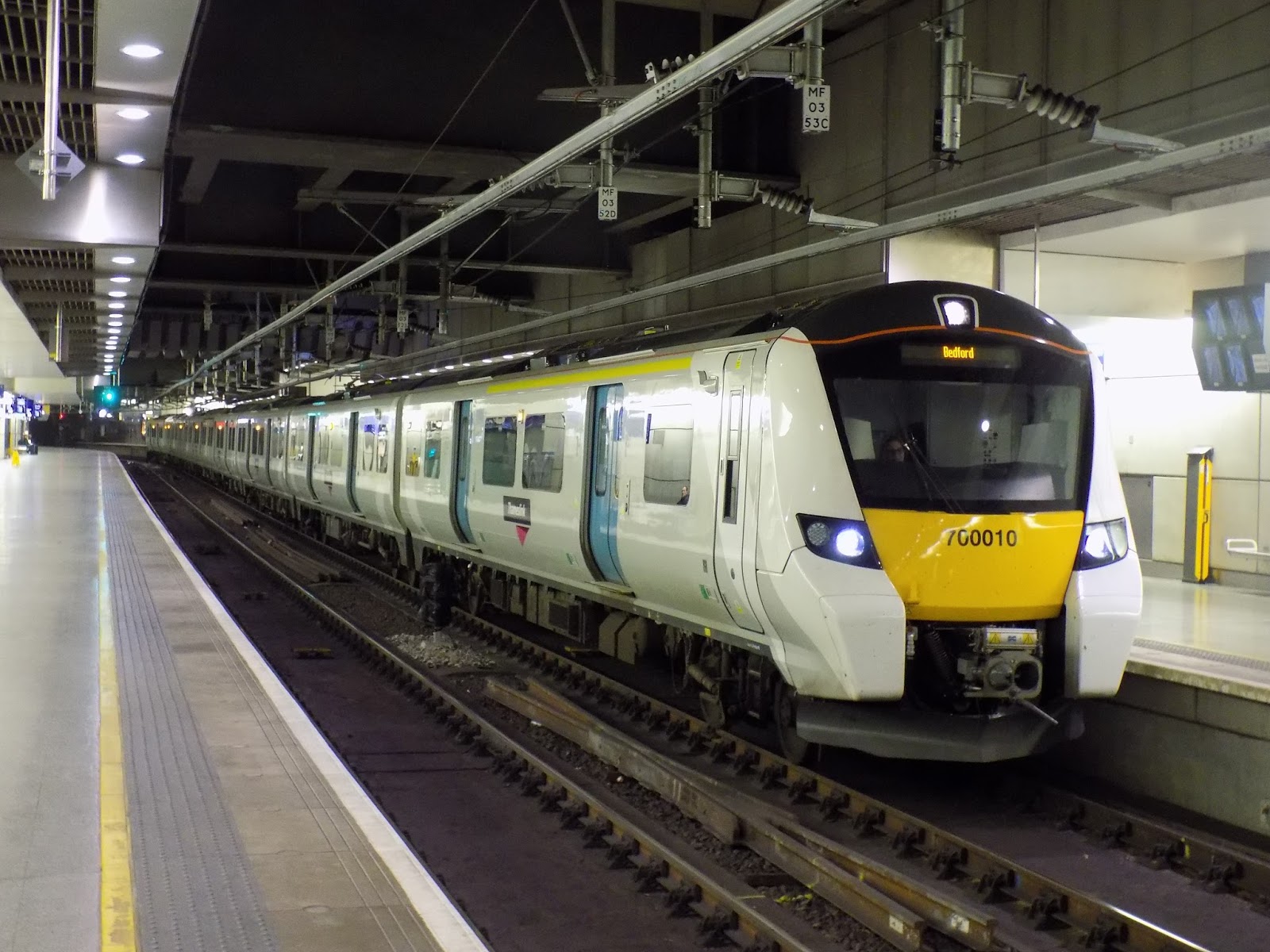
ThamesLink 700010 at London St. Pancras.

If I was to ask you what London rail project is to unveil later this year that has been in the works since the turn of the millennium, chances are you'd say Crossrail (or the Elizabeth line). But how many of you actually said the ThamesLink programme? But why does this project keep being side-stepped, particularly in reference to Crossrail when it's just as big, if not bigger?

Let's talk trains
Due to officially and gradually open later this year, the ThamesLink programme is a massive rail project to connect more towns and cities in the West Anglia and Bedfordshire, through the heart of London and to spawn out the other end in Kent and Sussex in a north to south format. There will be an array of regional commuter and metro trains involved, providing a first time direct link from Cambridge to Brighton and Maidstone, and Luton to Rainham (not our one, the one in Kent) via Bluewater, Dartford and Gravesend.

As a regular traveler on the ThamesLink and Great Northern rail routes, the difference over the last few years is black and white. Although whilst the companies have been constantly named and shamed for their poor reliability and other issues within that field, we have to remember the much more grim days of First Capital Connect. That said, I'm pretty sure that along with sister company Southern, that whole TSGN franchise is up there again for the worst train operating company (TOC) in the country award again by Which? for the 3rd year running.

The stations were often grotty and were slowly falling apart, not maintained well, dirty and lack of staff presence across the network. Now that's flipped around with the grey and pink being dashed out everywhere (and grey and blue, but not as much). But ThamesLink, maybe not Great Northern as much, has come quite a long way and I've always believed that credit does need to be given where its due.


So what is the final result of the ThamesLink programme?
On the internet, the exact answer to that has always been quite difficult to find, especially when it comes to finding out service frequencies and destinations as these keep changing over the years during several consultation periods.

ThamesLink 700018 at Streatham.
From what I've gathered, the services that have always stayed on each consultation period for ThamesLink:

  • The current Bedford to Brighton service via St Pancras, London Blackfriars, London Bridge and Gatwick Airport.
  • The Sevenoaks to London Blackfriars service, also dubbed 'The Cinderella line', will be extended to Kentish Town (or truncated from West Hampstead Thameslink, depends how you see it) for most of the day. It gets a much needed frequency increase to 4 trains per hour. The Orpington service will complement this as well.
  • The Luton to Sutton via Wimbledon 'Metro' service will be cut back to terminate at St. Alban's City. The current St. Alban's City to Sutton via Mitcham will continue to terminate here. 
With Great Northern, through the soon to be opened Canal tunnel from St. Pancras to Finsbury Park, it connects the ThamesLink line and the East Coast Main Line. This will allow trains every few minutes to run through here allowing the direct connection from the Anglia region to Sussex.

Great Northern:
  • The current Peterborough to London King's Cross service will be re-routed to London St. Pancras International, then continues via London Bridge and Redhill to terminate at Horsham.
  • The current Cambridge stopping and semi-fast services to London King's Cross will be re-routed to London St. Pancras International, then continues via London Bridge to either Brighton or Maidstone East*.
  • The King's Lynn to London King's Cross 'fast' services, that run non-stop from Cambridge will not run via the ThamesLink core. It will be one of the few, if only, remaining regular service at London King's Cross during the day**.
  • The Welwyn Garden City Metro service will, during the peak, be extended to Sevenoaks.
*First small print is that this had originally been planned to be two trains an hour to Brighton, and two trains an hour to Tattenham Corner. However, many stakeholders saw this as a waste of resources (the choice was random, even we have to say) and available paths, and decided to send the trains to the much bigger town (and as a destination too), Maidstone East. 

Interestingly, ThamesLink has taken a short-term decision to not run trains beyond Finsbury Park to Maidstone East on Sundays, where trains, as now, will run into London King's Cross at an hourly frequency instead. The Brighton variant of the service will continue to still run through the core.

**The second small print is that it was intended for the ThamesLink programme to make it all the way to King's Lynn. However, due to infrastructure issues, particularly relating to the platform lengths (a few stations on the line can only hold 4-cars) and power supply restrictions that would not be able to handle 8 or 12-car trains, it's put a dead end to what was a promising view for the Fen Line passengers. In the short run anyways, we can only hope.

As a result, the London King's Cross to King's Lynn train will continue to be operated by the class 387 'Electrostar' trains that have just been introduced last year.

Another interesting addition is a brand new route from ThamesLink. As aforementioned, a new metro train service from Luton to Rainham in Kent calling at all stations (it runs fast Mill Hill Broadway to West Hampstead ThamesLink) every half-hour using brand new dual-voltage trains. This service would run through North, Central and South London before making its way out via Bluewater [Greenhithe], Gravesend, Gillingham (Kent, not Dorset - but you should have figured that out by now) before terminating at Rainham. 

This replaces the London Charing Cross to Gillingham semi-fast service currently operated by Southeastern using class 465 Networkers and also the Sutton loop trains north of St. Alban's City. 
Moorgate station, rather grim.

Did we mention it runs at night too?
ThamesLink is one of very few operating companies to run trains throughout the night. The only other ones I can think of whilst writing this is sister company Southern (who withdrew half of their services late last year anyways), Transpennine Express (does this really count when it's once every 3 or so hours?) and the newly introduced night London Overground which only runs weekends. Oh, and of course the Caledonian Sleeper franchise too.

Trains will continue to run hourly, with the option to pursue a half hourly service in the future, calling at all ThamesLink stations between Bedford and London Bridge, followed by East Croydon, Gatwick Airport and Three Bridges.

Give them credit, they were here before the night tube, 7 days a week too.

Improvements to stations
Bar the broken promise with King's Lynn and the Fen Line, all stations will see an improvement in reflection of the fact that their rail services are majorly improving. Some of the flagship work has taken place around the biggest stations in Central London, a headlining one being Network Rail's London Bridge station. Others include the relatively new (2007) London St. Pancras International, London Blackfriars (2012) and City ThamesLink (1990s - but it still looks the part nearly 25 years later). 

The platforms at London Blackfriars station
A futuristic look has been given to them, but when I say that, it's not like the dull metal display that you'd find on the Jubilee line extension. Maybe St. Pancras' is to an extent but otherwise it's a carefully thought, well-designed, light, airy and modern design that even has a reflective vibe surrounding this. I still argue to this day that the renovated London Blackfriars station has to be one of the best stations you can find in London. The shell is mostly made of glass, with the platforms hovering above the River Thames (possibly the only station in the country to do so) spanning the full width of the river. It allows for an undisputed view of London's biggest waterway, bridges and myriads of well identified office buildings and of course the South Bank. 

The grade listed station at Farringdon, together with the London Underground, has had its original engine shed roof from when the Metropolitan Railway first started restored to its former glory. Mass expansion, particularly of the platforms, has allowed for more capacity during the rush hour and when the programme fully opens up (blocking off access to the City Widened lines to Moorgate - that explains the abandoned platforms at Barbican and Moorgate). What's more important is that Farringdon has lately seen an overhaul on the London Underground side, but now the ThamesLink Programme and Elizabeth line are planned to interchange here. In over a year's time you can get a train to Heathrow, Gatwick and Luton Airports from here!

The new entrance at London Bridge.

Part of the station forecourt at London Bridge.

The new London Bridge station had in fact opened another entrance following the New Year's, being the final leg of the station renovation project. Whilst some platforms remain closed until May as no trains will operate from [them], it has adopted an airport style concourse. Yes, it's equipped with gates that have lit arrows and crosses above them to show what gate you can go through and can't. The new arcade as well is quite grand and has quickly caught the attention of enthusiasts and passengers alike, no doubt that Network Rail really took pride in this particular station - the 4th busiest in the whole country.

GONE: Repainted ThamesLink 319444 'City of St. Albans' at Farringdon.
A full fleet of new trains
To help maximise and modernise the extent of this revolutionsed rail network, the Department for Transport (DfT) commissioned for a fleet of 115 brand new dual-voltage electric trains to be ordered. Dual voltage, because the ThamesLink line is one of few unique railways in the UK where trains in passenger service have to switch between overhead lines and third rail to obtain their power at Farringdon.

German manufacturer Siemens had won the contract to do this, building two new depots at Three Bridges in Sussex (that's just south of Gatwick Airport) and Hornsey in North London to station this huge fleet out of. A promise was made to hire more people into the engineering aspect of this company expansion with apprenticeships making up a percentage of their work fleet. 

These new trains are essentially the rivals to the class 345 Aventra trains, were classified as the class 700 Desiro City. This 'variant' of the series - the more appropriate way to put it - was its debut in the United Kingdom based on the success of the much-loved Desiro trains that have been in service since the early 2000s. They come fitted in either 8 or 12 coach fixed formations, walk-through, fully air-conditioned, toilets, charging points and at-seat tables and a first class section. The trains were built in two batches, with the 700/0s being 8-cars and found on the Metro services via Sutton and to Sevenoaks and Orpington, and the new service to Rainham and Maidstone East. They are currently found during the day working the Bedford to Brighton route as well however this won't be the case as much when the programme is in full swing, as this line, alongside Cambridge to Brighton will use the 12-car trains. 

ThamesLink 377510 in repainted neutral purple and sporting the
newer ThamesLink/ logo at Farringdon.
[These] replace the 30 year old class 319 trains that were withdrawn last summer from ThamesLink, which came in a 4-car formation. Enthusiasts find this particular class to be like marmite, either you love it or you hate it, so their farewell saw mixed reviews. It's not just the 319s they replace though, they also replace the class 377 'Electrostar' trains built by Bombardier as these move to Kent and work with Southeastern on their mainline routes as part of an enhancement programme. 

The first of the two depots to be opened was Three Bridges, and subsequently the first train was sent there and in early summer 2016, the first class 700 started service after a public exhibition to showcase the new design to the public was unveiled months earlier, 12-car 700108 ran a service from Brighton to London Bridge. Subsequently, after few teething issues, more quickly entered service and within about a year the whole ThamesLink fleet had been converted to class 700s including on the Metro services.

Passengers praise the trains for their more comfortable seats in comparison to the Aventra ones. The 700 is a train with more facilities doing the same distance as a typical Crossrail train on a Metro service. The passenger information system (PIS) has been noted for temporarily fuzzing out and being out of sync from time to time, however it tells you how busy the train is, live tube updates, the status of the toilets, safety notices and the calling pattern of the train. 

The displaced class 319s have now either gone to storage, or are being converted into class 769 Flex bi-mode trains for use up north on partially electrified lines (similar to the class 230 D train from our old D-stock). Some 319s are also getting a new lease of life as increasing more and more are coming to new operator London Northwestern Railway (West Midlands Trains) to enhance capacity on the southern stretch of the West Coast Main Line between Northampton and London Euston, particularly when a new, revised and higher frequency timetable is introduced this December.

Brand new 700031 at London St. Pancras.

ThamesLink to Horsham and Littlehampton
In the last timetable change during December 2017, ThamesLink took over, using class 700s, some of Southern's diagrams from London Bridge to Horsham via Redhill and to Littlehampton, a spur off the West Coastway line.

Two trains, via Redhill, runs approximately every 60-90 minutes all day Monday to Fridays between London Bridge and Horsham as ThamesLink. This allows for a smoother transition when this service becomes more high frequency and is extended to Peterborough via Finsbury Park. 

The service to Littlehampton runs just twice a weekday under the ThamesLink flag in each direction in the peak direction of travel. Majority of services, and all stations continue to be operated by Southern. 

Some trains are currently stored on the East Coastway as well down at Eastbourne, providing a useful berthing facility overnight.

The Northern City line to Moorgate
A separate line to the rest of the programme but happens to be getting its upgrade right now and does interwork its way into this, as it's operated by Great Northern. There are two lines right now, from Moorgate to Welwyn Garden City and Moorgate to Letchworth Garden City via Hertford North. Majority of trains terminate at Hertford North.

Great Northern 313123 at Finsbury Park bound for Moorgate.
However, due to the sheer intensity of the ThamesLink programme, track and capacity space is being utilised to its breaking point around the Stevenage area and a proposal set forward to relieve this issue is to cut the Letchworth services back to Watton-at-Stone and provide a reverse enabling facility (i.e. crossover). A bus would then run the rail replacement service until further notice between Watton-at-Stone and Stevenage where passengers can connect to rail transport once again. 

More capacity is being provided with an additional 30 Siemens Desiro City trains being ordered for the Moorgate services, all of them to a fixed six-car length and of similar design. However, they will be equipped with cab door exits in the event of an emergency in the Moorgate tunnels and will be standard class throughout. These will also be stationed at Hornsey. These variants are called the class 717s and will mainly be confined to this line replacing the class 313s, the oldest EMU mainline trains still in service. 

The ThamesLink, Northern City and Northern lines
An interesting conflict arose this week between ThamesLink, the press and Transport for London (TfL) for not showing or advertising the ThamesLink programme throughout the duration of the works, or displaying this on pocket tube maps. Several parties who had commented on the matter stated that it was 'secretly' in interest to protect their revenue, which had been falling over the last year, and did not want to lose London based competition to a rival company, even though ThamesLink is considered the second 'Northern line' essentially. It does go from Tooting to Mill Hill, though.

So far, this is the story of a Cinderella line. After billions of investment, and station upgrades, new trains and better connectivity, this one ugly duckling will be sure to turn heads when it rolls out later this year.

We would like to send a huge thanks to all our half a million and counting readers who have kept the blog alive for the last 5 years to this day! 

And now that you've read this post, why not visit the amazing London Buses: On The Go who also turned 5 today!